Supermarket Checkout Simulation
Can a supermarket run fewer self-checkouts without longer lines? An Arena model built on six weeks of real transaction data says yes.
the question
Shoppers pick stores with short lines, and every checkout lane costs money to keep running. We tested whether a supermarket could remove checkout stations and keep customer wait the same while cutting operating cost.
The data was real: six weeks of transaction and cashier logs from a grocery store in one of Europe's major chains, published by the operations research department at the Wroclaw University of Science and Technology.
input analysis
Each process was fit in Arena's Input Analyzer and checked with a chi-square test:
- Cashier service time:
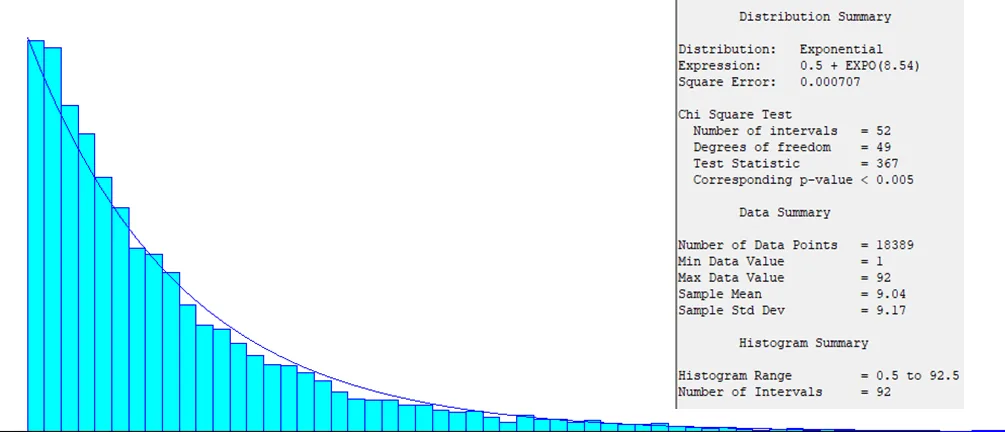
GAMM(0.585, 1.81) - Items per basket:
0.5 + EXPO(8.54)at self-checkout,0.999 + EXPO(15.4)at cashier lanes - Customer interarrival time:
-0.001 + EXPO(4.39)
The logs only record when scanning starts and ends - not when a customer joins the line - so scanning, payment, and bagging were modeled as one checkout service. The model assumes a 20-hour store day, one server per cashier lane, and no breaks.
the model
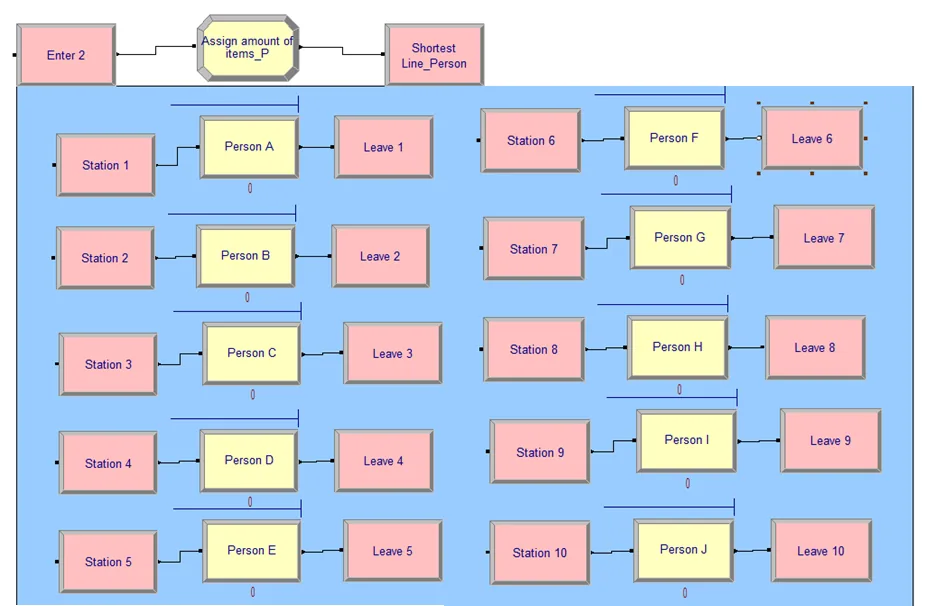
Customers arrive, spend time collecting items, then choose self-checkout or a cashier lane. A PickStation module sends each customer to the station with the shortest checkout, across 6 self-service and 10 cashier stations, then out of the store.
validation
Does the model behave like the store?
Over 8 replications the model's mean service time was 2.00 minutes against an observed 1.68 (s = 0.57). With t0 = 1.59 below the critical t0.025,7 = 2.365 at α = 0.05, we failed to reject the null hypothesis - the model is consistent with the real system - and the simulated self-service time distribution matched the observed one.
results
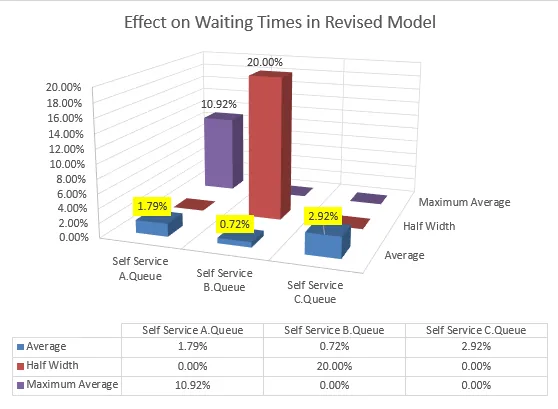
- Over a simulated 20-hour day, three self-checkouts sat idle most of the time. Removing them left store throughput unchanged and moved the self-service queue by under 3%.
- Estimated annual equipment cost fell from $42,500 (6 kiosks at about $6,000 each plus 10 belt lanes at about $650 each) to $24,500 - a 42.35% reduction - while keeping every cashier lane open for holiday peaks.
what I'd do next
The cost side used published industry averages, not this store's contracts, and the model ran an average day. The next steps would be the store's real maintenance costs and a peak-day scenario before removing anything.